
You pay $300 toward your cards. The car needs a $400 repair. The money is not there, so the repair goes on the card, and you are back where you started. This is the loop that keeps people in debt for years. It is not a willpower problem. It is a missing buffer problem.
The fix is not to save a full emergency fund before you touch the debt. That takes too long, and the card interest eats you alive while you save. The fix is a small buffer first, then the debt, then the full fund. In that order.
Should I save emergency fund or pay off debt first
Both. In sequence, not at the same time.
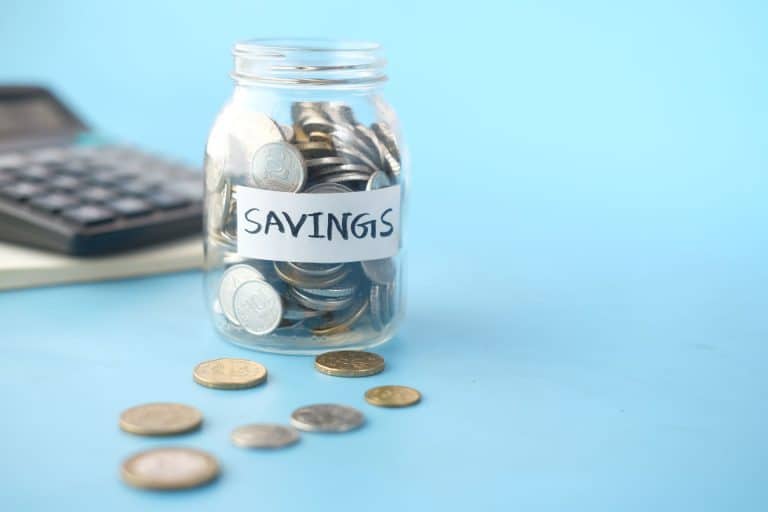
Step one is a $1,000 starter fund. Step two is aggressive debt payoff. Step three is the full 3 to 6 month fund. The starter fund exists for one job only: to stop the next surprise from going back on a card.
The math behind the order is simple. The average credit card APR in 2026 is 22.36 percent for accounts that are charged interest, according to the Federal Reserve. On a $5,000 balance, that is $1,118 of interest in a year if the balance stays flat, or about $93 a month. Every dollar you send to the card instead of a savings account saves you far more than any savings account pays. That is why the debt comes second, not last.
But the debt cannot come first either. With no buffer at all, the first emergency lands on the card at 22.36 percent, and the payoff plan breaks in month one. The $1,000 is insurance for the plan, not an investment. You are not choosing saving over debt payoff. You are buying the plan a chance to survive contact with real life.
One exception. If your employer offers a 401(k) match, take the full match before either step. A match is free money, and no debt payoff beats it. If there is no match, skip this step and start with the $1,000.
Emergency fund while in debt how much
The starter fund is $1,000. That number is a starter target from common beginner guidance, not a rule carved in stone. It is small enough to reach in weeks or a few months, and large enough to cover the most common surprises: a car battery, a tire, a plumber visit, a prescription.
How fast you get there depends on what you can set aside. At $50 a week, $1,000 takes 20 weeks. At $25 a week, it takes 40 weeks. At $100 a month, it takes 10 months. Pick the amount you can actually sustain, automate it for the day after payday, and do not touch it for anything that is not a real emergency. The next section defines what counts.
The full fund comes later, after the expensive debt is gone. The full fund is 3 to 6 months of essential expenses, not 3 to 6 months of income. Essentials means rent, utilities, groceries, transport, insurance, and minimum payments on any remaining debt. It does not mean eating out, streaming, or holidays.
Work it out with your own numbers. If your essentials are $3,000 a month, the full fund is $9,000 for 3 months and $18,000 for 6 months. That shows what the starter fund is and is not. At $100 a day of essentials, $1,000 covers about 10 days. It is a shock absorber, not a safety net. It buys you time to deal with one problem without new debt. It does not carry you through a job loss. That is the full fund’s job, and it comes after the cards are cleared.
If your income is unstable, aim for the 6 month end of the range once the debt is gone. If your job is steady and you have two incomes in the household, 3 months is a reasonable target. Either way, build it in the same high yield savings account as the starter fund, and keep adding until you hit your number.
Where to keep it
Keep the starter fund in a separate high yield savings account, in a different bank from your everyday checking if you can. Separate matters more than the rate. Money sitting in checking gets spent. Money in a separate account takes a transfer and a day to reach, and that friction is the point.
Do not keep it in cash at home. Cash at home earns nothing, is easy to spend, and is gone if the house is burgled or floods. Do not invest it. Money you may need next month does not belong in the stock market, where it can fall by a fifth in a bad quarter. The companion post on investing makes the same point from the other side: only invest money you will not need for at least five years. Emergency money is the opposite of that.
Do not keep it on a card either. Available credit is not an emergency fund. It is the thing you are trying to escape, at 22.36 percent.
What counts as a real emergency
Use the fund only when three things are all true. The expense is unexpected. It is necessary. And it is urgent. If any one of those is missing, it is not an emergency.
Real emergencies: a car repair that keeps you getting to work, an urgent medical or dental bill, a broken furnace in winter, a burst pipe, a vet bill for a pet that needs treatment now, a sudden job loss. These are unexpected, necessary, and urgent.
Not emergencies: a sale, a holiday, a wedding gift, a new phone when the old one still works, concert tickets, a car upgrade, Christmas presents, a gym membership. These are either expected, or optional, or both. Christmas comes every year on the same date. That is a planned expense, not an emergency, and it belongs in its own sinking fund.
When in doubt, wait 48 hours. A real emergency is still urgent after two days. A want usually fades.
If you have to use it, rebuild it first
Using the fund is not failure. That is what it is for. The mistake is using it and never refilling it, so the next surprise has nowhere to go but the card.
The rule is simple. The month after you use the fund, pause the extra debt payments and rebuild the starter fund back to $1,000 first. Keep paying the minimums on every card while you rebuild, so nothing goes late. Once the fund is back to $1,000, resume the extra payments. A 0 percent balance transfer can also buy breathing room while you rebuild, if you can clear the balance inside the window: 0% Balance Transfer Cards in 2026.
This is the same order as the full debt plan: minimums on everything, starter buffer, then the highest APR card first. That order is here: How to Get Out of Debt: A Beginner’s 8-Step Plan. The APR math behind it is here: Average Credit Card APR 2026. That post shows why minimum payments are so costly: a $10,000 balance at 22.36 percent takes 25 years to clear on minimum payments alone.
Your first month plan
Week one: open a separate high yield savings account and set an automatic transfer for the day after payday, even if it is only $25 a week. Week two: list your essential monthly expenses and multiply by 3, so you know what the full fund target will be later. Week three: write your emergency list on a card and keep it with the account details, so the decision is already made when something breaks. Week four: check the balance, leave it alone, and keep the transfer running until it hits $1,000. Then switch the same automatic amount toward the highest APR card.
The bottom line
Save $1,000 first, then attack the cards, then build the full 3 to 6 month fund. The starter fund is not savings for its own sake. It is the thing that stops the next surprise from going back on a card at 22.36 percent. For the full payoff journey, UNOWED: The Step-by-Step Beginner’s Guide to Getting Out of Debt and Staying Out, it covers it in eight chapters.
If you are in the UK, the same order works, but the accounts and rates are different. A separate easy access savings account plays the same role as a US high yield savings account.
This article is general information only, not personal financial advice. Your APR, expenses, and account options will differ, so check your card agreement and your bank’s terms before you act.
Figures last checked 14 November 2026.
Sources
- Federal Reserve, G.19 Consumer Credit, release dated 6 November 2026, September 2026 and third quarter 2026 data, read in full 14 November 2026: average APR on credit card accounts at commercial banks, accounts assessed interest 22.36 percent in the third quarter, 22.15 percent in the second quarter, 21.52 percent in the first quarter. All accounts 21.19 percent in the third quarter. Revolving credit outstanding $1,368.5 billion seasonally adjusted in the third quarter.
- Federal Reserve Bank of New York, Quarterly Report on Household Debt and Credit, third quarter 2026, press release dated 10 November 2026, read in full 14 November 2026: total household debt $19.105 trillion, up $334 billion in the quarter. Credit card balances $1.285 trillion, up $22 billion in the quarter and up $52 billion from a year earlier. 5.0 percent of outstanding debt in some stage of delinquency, up from 4.7 percent in the previous quarter. Flow into serious delinquency for credit card debt 6.87 percent, down from 7.05 percent a year earlier.
- Starter fund build times and full fund examples, site’s own calculation, 14 November 2026: $1,000 at $50 a week takes 20 weeks, at $25 a week takes 40 weeks, at $100 a month takes 10 months. Essentials of $3,000 a month give a full fund of $9,000 for 3 months and $18,000 for 6 months, and $1,000 covers about 10 days at $100 a day. Interest on a flat $5,000 balance at 22.36 percent is $1,118 a year, about $93 a month.
- Pexels, photo 7680480, Kaboompics, https://www.pexels.com/photo/7680480/, free license. File checked visually on 14 November 2026, no legible brand logo.